How to Build a Browser OCR Tool with Tesseract.js
Learn how to build a browser-based OCR app using Tesseract.js. Extract text from images directly in the browser with a simple client-side setup.


Suggested:
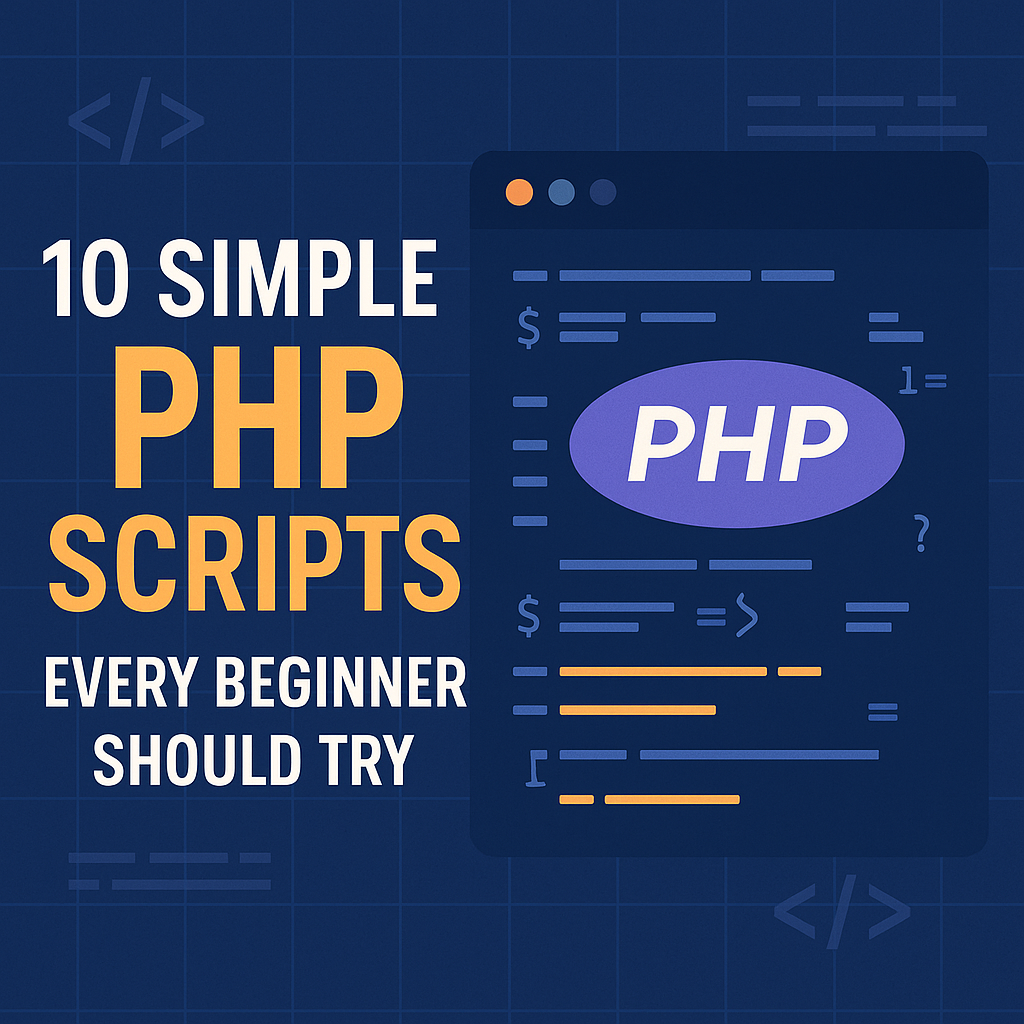
Learn PHP fast with these 10 beginner-friendly scripts! From master PHP basics like form handling, sessions, and file uploads—no database required.
To help you get started, we've compiled 10 simple PHP scripts every beginner should try. These projects will help you practice real-world logic, form handling, session management, file operations, and more.
Table of contents [Show]
A contact form is often the first thing developers build—and for good reason. It introduces core concepts like form handling and input sanitization.
$_POST, HTML forms, filter_var(), htmlspecialchars()<?php
if ($_SERVER["REQUEST_METHOD"] == "POST") {
$name = htmlspecialchars(trim($_POST["name"]));
$email = filter_var(trim($_POST["email"]), FILTER_SANITIZE_EMAIL);
if (!filter_var($email, FILTER_VALIDATE_EMAIL)) {
echo "Invalid email format";
} else {
echo "Thanks, $name!";
}
}
?>This teaches session handling and form comparisons without diving into database management—yet.
$_SESSION, conditionals, header()<?php
session_start();
$correct_user = "admin";
$correct_pass = "password";
if ($_POST["username"] === $correct_user && $_POST["password"] === $correct_pass) {
$_SESSION["loggedin"] = true;
header("Location: dashboard.php");
} else {
echo "Invalid credentials";
}
?>Every site needs analytics. Start simple with a flat file hit counter.
fopen(), fwrite()<?php
$file = 'counter.txt';
$hits = file_exists($file) ? (int)file_get_contents($file) : 0;
$hits++;
file_put_contents($file, $hits);
echo "Visitor count: $hits";
?>Learn about strings and randomness with this simple script.
str_shuffle(), custom functions<?php
function generatePassword($length = 10) {
$chars = 'abcdefghijklmnopqrstuvwxyzABCDEFGHIJKLMNOPQRSTUVWXYZ0123456789!@#$%^&*()';
return substr(str_shuffle($chars), 0, $length);
}
echo generatePassword(12);
?>Uploading files is a core web app feature. This teaches file handling and server storage.
$_FILES, move_uploaded_file(), file security<?php
if ($_FILES["file"]["error"] === UPLOAD_ERR_OK) {
$uploadDir = "uploads/";
$uploadFile = $uploadDir . basename($_FILES["file"]["name"]);
move_uploaded_file($_FILES["file"]["tmp_name"], $uploadFile);
echo "File uploaded!";
}
?>Preserve form values after submission.
<?php
$name = $_POST["name"] ?? '';
?>
<form method="POST">
  <input type="text" name="name" value="<?php echo htmlspecialchars($name); ?>">
  <input type="submit">
</form>A to-do app is a great way to learn about arrays, loops, and session storage.
$_SESSION, dynamic output<?php
session_start();
$_SESSION["tasks"] = $_SESSION["tasks"] ?? [];
if (!empty($_POST["task"])) {
$_SESSION["tasks"][] = htmlspecialchars($_POST["task"]);
}
foreach ($_SESSION["tasks"] as $task) {
echo "<li>$task</li>";
}
?>Learn how to send emails from your server.
mail(), HTML headers<?php
$to = "example@example.com";
$subject = "Test Mail";
$message = "<h1>This is a test</h1>";
$headers = "Content-type:text/html\r\n";
mail($to, $subject, $message, $headers);
?>⚠️ Note: Many shared hosts disable mail(). Consider PHPMailer for production.
Introduce date logic and form input handling.
DateTime class, diff() method<?php
$dob = new DateTime($_POST["dob"]);
$today = new DateTime();
$age = $today->diff($dob)->y;
echo "You are $age years old.";
?>Great for mastering conditionals, math operations, and form structure.
switch statements<?php
$num1 = $_POST['num1'] ?? 0;
$num2 = $_POST['num2'] ?? 0;
$operator = $_POST['operator'] ?? '+';
switch ($operator) {
case '+': $result = $num1 + $num2; break;
case '-': $result = $num1 - $num2; break;
case '*': $result = $num1 * $num2; break;
case '/': $result = $num2 != 0 ? $num1 / $num2 : 'Error'; break;
}
echo "Result: $result";
?>These simple scripts may appear basic, but they lay the groundwork for more advanced applications. Once you're comfortable, try integrating databases (like MySQL), using frameworks (like Laravel), or securing your apps against attacks (XSS, CSRF, SQL injection). Mastery starts with understanding the building blocks.
Remember: Practice is essential. Code each script yourself, tweak it, and break it. That’s where the real learning happens.
Learn how to build a browser-based OCR app using Tesseract.js. Extract text from images directly in the browser with a simple client-side setup.
Step-by-step guide to creating a PHP backend that removes image backgrounds using Remove.bg API. Ideal for developers building automated image tools
Learn how to create a real-time PHP chat app using MySQL and JavaScript with user login, typing status, chat history deletion, and a modern, responsive UI.